
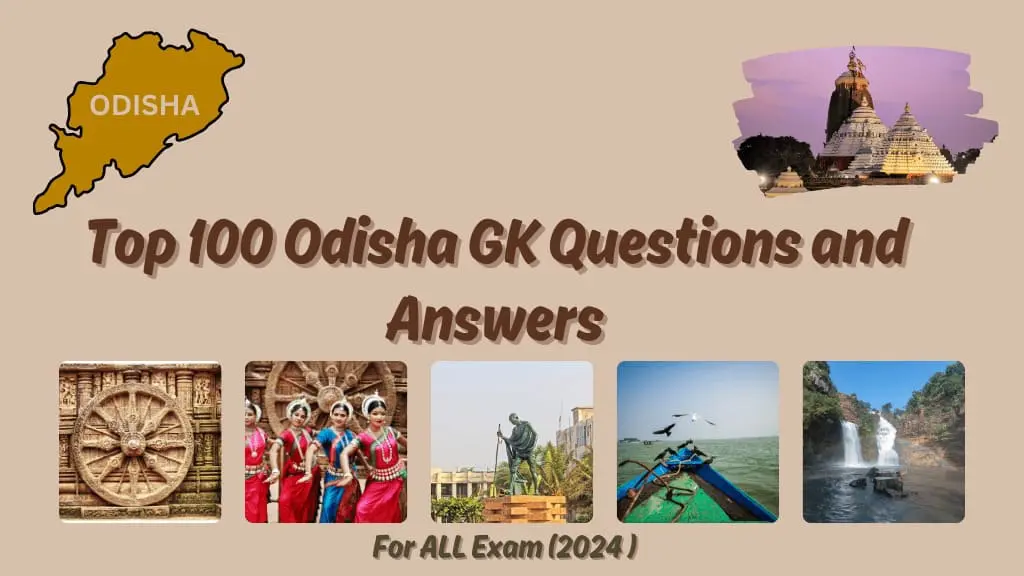
It will take you 30 to 45 minutes to read through this entire guide the first time. Save it to look over again and again! Now let me ask you some things: Are you studying for an important test? Want to know sound, up-to-date facts about Odisha GK? Are you sick of study materials that aren’t full or are out of date? You’ve come to the right place if you said “yes” to any of these questions. I’ve spent a lot of time exploring, collecting, and organizing 150 complete Odisha General Knowledge questions with detailed answers that are perfect for people who are studying for competitive exams.
Not just any general knowledge book—this one has been carefully chosen to include both quick-reference answers and in-depth explanations that will help you understand not only “what” but also “why.”
- STATE SYMBOLS & ADMINISTRATION
- GEOGRAPHY & TOPOGRAPHY ON ODISHA GK
- RIVERS, LAKES & WATER SYSTEMS FOR OSSC OPSC EXAM PREPARATION
- WILDLIFE & NATIONAL PARKS OF ODISHA GENERAL KNOWLEDGE
- HISTORY & KALINGA KINGDOM
- FREEDOM MOVEMENT & MODERN POLITICS
- CULTURE, FESTIVALS & TRADITIONS
- LANGUAGE, LITERATURE & ARTS
- ECONOMY, INDUSTRIES & RESOURCES
- NOTABLE PERSONALITIES & ACHIEVEMENTS
- MISCELLANEOUS & FUN FACTS
- ADDITIONAL CURRENT AFFAIRS QUESTIONS (Q121-150)
- Conclusion
- Frequently Asked Questions (FAQ)
STATE SYMBOLS & ADMINISTRATION

By Krupasindhu Muduli – Own work, CC BY-SA 3.0, Link
Q1. What is the capital of Odisha?
[Bhubaneswar (since 1948)]
Bhubaneswar became the capital of Odisha in 1948 and was officially announced in 1949, replacing the flood-prone Cuttack. The shift was driven by Cuttack’s vulnerability to Mahanadi River flooding and the need for modern planned urban development. Bhubaneswar now serves as the administrative, legislative, and cultural center of the state with continuous expansion projects.
Q2. What is the area of Odisha?
[155,707 square kilometers]
Odisha covers an area of 155,707 square kilometers, representing 4.73% of India’s total geographical area. This makes Odisha the 8th largest state by area in India, with a distinctive geography comprising coastal plains, laterite plateaus, and hilly terrain in different regions.
Q3. What is the population of Odisha (2011 Census)?
[42.3 million (42,282,668)]
According to the 2011 Census, Odisha has a population of 42.3 million people, making it the 11th most populous state in India. Current 2025 estimates suggest the population has grown to approximately 45-46 million based on annual growth rates.
Q4. How many districts does Odisha have?
[30 districts]
Odisha comprises 30 administrative districts organized across different regions. These districts are subdivided into multiple blocks and municipalities, facilitating governance and administration at grassroots levels across the state.

By Jayanta Nath – Own workInternational Borders: University of Texas map library – India Political map 2001Disputed Borders: University of Texas map library – China-India Borders – Eastern Sector 1988 & Western Sector 1988 – Kashmir Region 2004 – Kashmir Maps.State and District boundaries: Census of India – 2001 Census State Maps – Survey of India Maps.Other sources: US Army Map Service, Survey of India Map Explorer, Columbia UniversityMap specific sources: ., CC BY-SA 3.0, Link
Q5. What is the state animal of Odisha?
[Sambar Deer]
The Sambar Deer (Rusa unicolor) is the state animal of Odisha, found in the forested regions of the state. This large deer species represents Odisha’s wildlife wealth and is protected under various conservation initiatives and national parks.
Q6. What is the state bird of Odisha?
[Indian Roller (Blue Jay)]
The Indian Roller, also called the Blue Jay (Coracias benghalensis), is Odisha’s state bird. Known for its vibrant blue coloration and acrobatic flights, it is commonly found throughout Odisha and represents the state’s avian diversity.
Q7. What is the state flower of Odisha?
[Ashoka Flower]
The Ashoka flower (Saraca asoca) is Odisha’s state flower, known for its yellow and reddish flowers. Sacred in Hindu and Buddhist traditions, it holds religious significance and is featured in various religious rituals and temple decorations across the state.
Q8. What is the state tree of Odisha?
[Peepal Tree (Ashwattha/Ficus religiosa)]
The Peepal Tree, known scientifically as Ficus religiosa, is Odisha’s state tree. Sacred in Hindu and Buddhist traditions, it symbolizes spiritual and environmental significance, featuring prominently in religious practices and traditional medicine systems.
Q9. What is the state fish of Odisha?
[Mahanadi Mahseer]
The Mahanadi Mahseer (a large cyprinid fish species) is Odisha’s state fish, found in the Mahanadi River system. This fish is economically important for local fisheries and represents the river’s ecological wealth.
Q10. What is the state fruit of Odisha?
[Mango]
The Mango is Odisha’s state fruit, reflecting the state’s significant mango production and cultural connection to this fruit. Odisha is one of India’s major mango-producing states, known for high-quality varieties.
GEOGRAPHY & TOPOGRAPHY ON ODISHA GK
Q11. In which part of India is Odisha located?
[Eastern India]
Odisha is located in the eastern part of India in the Deccan Peninsula’s southeastern region. It forms part of India’s eastern coastline along the Bay of Bengal, giving it strategic geographical and economic importance for maritime trade and tourism.

By फ़िलप्रो (Filpro) – File:India dark grey.svg, CC BY-SA 4.0, Link
Q12. What is Odisha’s rank by area in India?
[8th largest state]
Odisha ranks 8th among Indian states by area, covering 155,707 square kilometers. This ranking reflects its significant geographical extent and diverse topography spanning coastal plains to hilly regions.
Q13. What is Odisha’s rank by population in India?
[11th most populous state]
With a population of 42.3 million (2011 Census), Odisha ranks 11th among Indian states by population. The population is distributed across urban centers like Bhubaneswar and Cuttack and numerous rural areas.
Q14. What is the length of Odisha’s coastline?
[480 kilometers along Bay of Bengal]
Odisha has a coastline of 480 kilometers along the Bay of Bengal, making it an important maritime state. This coastline supports fishing, ports, tourism, and is ecologically significant for coastal ecosystems.
Q15. Which is the largest city in Odisha?
[Bhubaneswar]
Bhubaneswar is the largest and capital city of Odisha, serving as the administrative, cultural, and educational center. The city has undergone significant modernization and development, with ongoing smart city initiatives and expansion projects costing ₹8,179 crore to expand across 800 acres.
Q16. What percentage of India’s total land area does Odisha represent?
[4.73%]
Odisha represents 4.73% of India’s total geographical area, reflecting its significant territorial extent among Indian states. This substantial landmass supports diverse ecosystems, mineral resources, and agricultural production.
Q17. What is the highest peak in Odisha?
[Deomali (approximately 915 meters)]
Deomali, located in Koraput district in the Eastern Ghats, is Odisha’s highest peak at approximately 915 meters above sea level. It offers scenic views and is an important geographical landmark in the state’s southern region.
Q18. Which river is called the “Ganga of Odisha”?
[Baitarani River]
The Baitarani River is poetically referred to as the “Ganga of Odisha” due to its religious and cultural significance. Flowing through multiple districts, it supports agriculture, fisheries, and holds sacred importance for local communities.
Q19. What are the major physiographic regions of Odisha?
[Coastal plains, laterite plateaus, Eastern Ghats, alluvial plains, and hilly regions]
Odisha’s terrain comprises five major physiographic divisions: coastal plains along the Bay of Bengal with fertile deltas, laterite plateaus in central regions, Eastern Ghats mountain ranges in the western and southern areas, alluvial plains of river valleys, and elevated hilly terrain in districts like Koraput and Malkangiri.
Q20. What is Chilika Lake?
[Largest brackish water lagoon in Asia]
Chilika Lake, located in southern Odisha, is Asia’s largest brackish water lagoon spanning approximately 1,165 square kilometers. It supports diverse aquatic life, serves as a major fishing ground, and is a critical stopover for migratory birds, recognized as a Ramsar Wetland of International Importance.
RIVERS, LAKES & WATER SYSTEMS FOR OSSC OPSC EXAM PREPARATION
Q21. What is the longest river in Odisha?
[Mahanadi River]
The Mahanadi River, originating from the Amarkantak Plateau in Chhattisgarh, is Odisha’s longest and most significant river. With a total length of 851 kilometers (494 km in Odisha), it covers 42% of Odisha’s land area in its catchment, supporting agriculture, hydroelectric power, and forming fertile deltas crucial for rice cultivation.
Q22. Where does the Mahanadi River originate?
[Amarkantak Plateau in Chhattisgarh]
The Mahanadi originates from the Amarkantak hills of the Bastar Plateau in Raipur district of Chhattisgarh state. It then flows southeast through Odisha, forming multiple distributaries near Cuttack (creating Kathajodi and Birupa rivers) before emptying into the Bay of Bengal.
Q23. What is the Hirakud Dam?
[World’s largest earthen dam on Mahanadi River]
Hirakud Dam, constructed across the Mahanadi River, is the world’s longest and Asia’s largest earthen dam spanning approximately 26 kilometers. Built in 1957, it generates hydroelectric power, provides irrigation to vast agricultural areas, and creates a scenic reservoir for tourism.

By Government of Odisha – From Twitter account of Naveen Patnaik, CC BY 4.0, Link
Q24. What is the second largest river in Odisha?
[Brahmani River]
The Brahmani River, formed by the confluence of Sankh and Koel rivers near Rourkela in Sundargarh district, is Odisha’s second largest river. Spanning 799 kilometers (541 km in Odisha), it drains a catchment area of 39,033 square kilometers, supporting agriculture and multiple hydroelectric projects.
Q25. What are the major tributaries of the Mahanadi?
[Tel, Jira, Jhaun, and many others]
The Mahanadi has numerous tributaries including Tel, Jira, and Jhaun on the right bank, while the Jhaun and other streams form the left bank tributaries. These tributaries collectively enhance the Mahanadi’s water volume and support agriculture across extensive areas.
Q26. What is the Baitarani River?
[Third major river system of Odisha]
The Baitarani River, with a total length of 344 kilometers, is one of Odisha’s three major river systems. It flows through Keonjhar and Bhadrak districts, drains a significant basin, and has tributaries including the Deo and Indrani rivers before entering the Bay of Bengal.
Q27. What is Paradip Port?
[Major seaport on Mahanadi estuary]
Paradip Port, located on the Mahanadi estuary in Jagatsinghpur district, is one of India’s major seaports. It handles significant cargo traffic including mineral ores, coal, and other commodities, serving as a crucial gateway for Odisha’s maritime trade and economic development.
Q28. What is the Ansupa Lake?
[Largest freshwater lake in Odisha]
Ansupa Lake, located in Cuttack district along the Mahanadi River system, is Odisha’s largest freshwater lake. It serves as an important fishing ground, provides irrigation support, and has ecological significance as a wetland habitat supporting diverse flora and fauna.

Q29. What is the “Hexadeltaic region” of Odisha?
[Area formed by delta of six major rivers]
The Hexadeltaic region refers to the fertile coastal plain formed by the deltas of six major rivers: Mahanadi, Brahmani, Budhabalanga, Subarnarekha, Baitarani, and Rushikulya. This region is highly fertile, ideal for agriculture (especially rice), and forms a significant portion of Odisha’s economic base.
Q30. What are the major tributaries of the Brahmani River?
[Koel, Sankh, and various smaller streams]
The Brahmani is formed by the confluence of the Koel and Sankh rivers. It has additional tributaries and distributaries including Kharasua and Kelua, all contributing to its drainage system and agricultural productivity across eastern Odisha.
WILDLIFE & NATIONAL PARKS OF ODISHA GENERAL KNOWLEDGE
Q31. How many national parks does Odisha have?
[2 national parks (Bhitarkanika and Similipal)]
Odisha now has 2 national parks: Bhitarkanika National Park in Kendrapara district and Similipal National Park in Mayurbhanj district (notified as national park in April 2025). Similipal’s elevation to national park status marks a major conservation milestone for the state.

By Dreamodisha – Own work, CC BY-SA 3.0, Link
Q32. What is Similipal National Park?
[Largest national park in Odisha – 845.7 sq km]
Similipal National Park, formally notified in April 2025, covers 845.7 square kilometers in Mayurbhanj district, making it Odisha’s largest national park and India’s 107th national park. It represents a culmination of conservation efforts initiated in 1980 and now provides the highest protection level for wildlife.
Q33. What is Similipal Tiger Reserve?
[Largest tiger habitat in Odisha]
The Similipal Tiger Reserve (STR) spans 2,750 square kilometers and is Odisha’s largest tiger habitat. It is uniquely home to the world’s only population of melanistic (black) tigers, alongside Royal Bengal tigers, Asian elephants, and diverse endangered species.
Q34. What wildlife is found in Similipal National Park?
[40 Royal Bengal tigers, Asian elephants, 55 mammal species, 361 bird species, 62 reptile species]
Similipal harbors exceptional biodiversity including 40 Royal Bengal tigers, approximately one-quarter of Odisha’s elephant population, 55 mammal species, 361 bird species, 62 reptile species, 21 amphibian species, and 104 orchid species (many endemic), making it critically important for conservation.
Q35. What is Bhitarkanika National Park?
[Odisha’s first national park in coastal region]
Bhitarkanika National Park in Kendrapara district spans 672 square kilometers in the Mahanadi estuary. Known for crocodile conservation, mangrove ecosystems, and diverse wildlife, it was Odisha’s first national park and remains crucial for coastal biodiversity protection.
Q36. Why is Similipal famous for black tigers?
[World’s only population of melanistic tigers]
Similipal is uniquely distinguished as the world’s only natural habitat of melanistic (black) tigers, characterized by dark coats with faint yellow stripes. This rare genetic variation occurs naturally in Similipal’s population, making the reserve globally significant for tiger conservation and research.
Q37. How many wildlife sanctuaries does Odisha have?
[8+ wildlife sanctuaries]
Odisha has multiple wildlife sanctuaries including Nandankanan, Hadgarh, Korak, Satkosia, Balangir, and others. These sanctuaries protect specific ecosystems and species, complementing national parks in the state’s biodiversity conservation network.
Q38. What is Nandankanan Wildlife Sanctuary?
[Historic zoo and wildlife sanctuary in Bhubaneswar]
Nandankanan, located near Bhubaneswar, is famous as India’s first open zoo established in 1960. It combines wildlife conservation with public education, housing diverse species and conducting significant breeding programs for endangered animals.
Q39. What is the state rank of Odisha for Scheduled Tribe (ST) population?
[3rd highest ST population in India]
Odisha ranks 3rd in India for Scheduled Tribe population, with significant tribal communities including Kondh, Santal, and Bhuiyan peoples. These communities maintain traditional cultures, occupying forested regions and maintaining ecological knowledge systems.
Q40. What percentage of India’s mineral output comes from Odisha?
[40% of India’s mineral output by value]
Odisha accounts for 40% of India’s mineral output by value, making it a mineral-rich powerhouse. The state’s vast reserves of iron ore (28% of India’s total), coal (24%), bauxite (59%), and chromite (98%) form the foundation of this mineral wealth.

By Bikashkumargiri1997 – Own work, CC BY-SA 4.0, Link
HISTORY & KALINGA KINGDOM
Q41. What was the ancient name of Odisha?
[Kalinga or Odra Desha]
Odisha’s ancient names were Kalinga (references in Mahabharata and Buddhist texts) and Odra Desha. The name “Kalinga” appears in Ashoka’s edicts, historical epics, and ancient literature, while “Odra” is mentioned in Puranic texts. Modern “Odisha” is derived from “Odra.”
Q42. When did Ashoka invade Kalinga?
[261 BCE – Kalinga War]
Emperor Ashoka of the Mauryan Empire invaded the Kalinga Kingdom in 261 BCE, resulting in the devastating Kalinga War. This conflict killed approximately 100,000 people and caused immense suffering, leading Ashoka to embrace Buddhism and adopt a policy of compassionate rule, transforming him into “Ashoka the Great.”
Q43. What was the Kalinga War?
[Major battle in 261 BCE leading to Ashoka’s moral transformation]
The Kalinga War was fought between Emperor Ashoka and the Kalinga Kingdom, resulting in massive casualties (estimated 100,000 deaths). Witnessing this destruction, Ashoka renounced violent conquest, embraced Buddhism, and implemented the Dhamma (moral law), becoming one of history’s greatest emperors.
Q44. What was the ancient capital of Kalinga?
[Dantapur (ancient Tosali under Mauryans)]
The ancient capital of Kalinga was Dantapur, known in Buddhist texts as Dantapura. Under Mauryan rule following Ashoka’s conquest, Tosali (modern-day Dhauli) became the capital, serving as the administrative center of Odisha during the Mauryan period.

By Bernard Gagnon – Own work, CC BY-SA 3.0, Link
Q45. What are the Dhauli and Jaugada edicts?
[Ashoka’s rock edicts engraved in Kalinga after conquest]
The Dhauli and Jaugada rock edicts were inscribed by Emperor Ashoka to communicate his administrative policies, moral teachings (Dhamma), and governance principles to the people of Kalinga. These edicts reveal Mauryan administrative organization, including roles of Antamahamattas, Dharma Mahamattas, and Rajukas.
Q46. What was the significance of Ashoka’s Dhauli edict?
[Expression of remorse and new moral governance policy]
The Dhauli edict, carved on a rock near modern Bhubaneswar, expresses Ashoka’s remorse for the Kalinga War’s devastation. It announces his new policy of Dhamma (righteous governance), commitment to moral welfare of subjects, and the appointment of Dharma Mahamattas (officials for moral and spiritual welfare).
Q47. When did the Mauryan Empire rule Odisha?
[261 BCE – 185 BCE]
The Mauryan Empire ruled Odisha from 261 BCE (Ashoka’s conquest) until 185 BCE (fall of Mauryan Empire). During this period, Ashoka transformed the region morally and spiritually through Buddhism and Dhamma, leaving lasting influences on Odisha’s culture and religion.
Q48. What ancient kingdoms ruled Odisha besides Kalinga?
[Mata dynasty, Somavamshi dynasty, Ganga dynasty, Odisha kingdoms]
Before and after the Kalinga period, various dynasties ruled Odisha including the Nanda dynasty (350 BCE), Mathara dynasty (emphasizing Narayana/Vishnu worship), and later kingdoms. Each contributed to the region’s cultural, religious, and political development.
Q49. When was Cuttack established as capital?
[Medieval period – 997 CE by the Somavamshi dynasty]
Cuttack was established as the capital of Odisha in the 10th century by the Somavamshi dynasty around 997 CE. It served as the capital for centuries, becoming an important administrative, commercial, and cultural center before being replaced by Bhubaneswar in 1948.
Q50. Who built the Jagannath Temple in Puri?
[Anantavarman Chodaganga Dev initiated reconstruction in 1135 CE]
The Jagannath Temple’s major reconstruction was initiated by King Anantavarman Chodaganga Dev of the Somavamshi dynasty in 1135 CE. Building on earlier structures and legends, he transformed it into the magnificent temple complex visited by millions annually, making Puri one of Hinduism’s four sacred dhams.
FREEDOM MOVEMENT & MODERN POLITICS
.png#/media/File:Orissa_Flag(INDIA).png)
By AlexR.L. – Own work, CC BY-SA 3.0, Link
Q51. When was Odisha established as a state?
[1st April 1936]
Odisha was established as a separate state on 1st April 1936 under British rule. Prior to this, the territory comprised multiple princely states and British administrative regions. After independence in 1950, Odisha underwent multiple territorial reorganizations, eventually achieving its current boundaries following linguistic state reorganization in 1956.
Q52. When did Odisha become part of independent India?
[26th January 1950]
Odisha became part of the Indian Union on 26th January 1950 when India adopted its Constitution and became a sovereign democratic republic. The state underwent significant territorial changes post-independence, including merger of princely states and reorganization following linguistic principles established by the States Reorganization Commission.
Q53. Who was the first Chief Minister of independent Odisha?
[Harekrushna Mahatab]
Harekrushna Mahatab served as Odisha’s first Chief Minister after independence, governing from 1950-1961 with interruptions. He played crucial roles in post-independence state consolidation, integration of princely states, and establishing democratic governance frameworks in Odisha.
Q54. Who is the current Chief Minister of Odisha (2025)?
[Mohan Charan Majhi]
Mohan Charan Majhi has been serving as Chief Minister of Odisha since June 2024, leading the BJP government. He replaced Naveen Patnaik after decades of Biju Janata Dal (BJD) rule, representing a significant political transition in state governance.
Q55. Who was the longest-serving Chief Minister of Odisha?
[Naveen Patnaik (1997-2024, 27 years)]
Naveen Patnaik served as Chief Minister for an unprecedented 27 years (March 1997 to May 2024), making him India’s longest-serving Chief Minister. His tenure witnessed significant developmental initiatives, establishment of IT sector, and major infrastructure projects.
Q56. What is the Kalinga Jatra?
[Odisha’s significant freedom struggle movement]
The Kalinga Jatra represented the freedom movement in Odisha with various revolts against colonial rule. Multiple freedom fighters from Odisha, including members of revolutionary organizations, participated actively in India’s independence struggle against British colonial administration.
Q57. Who was Gopabandhu Das?
[Freedom fighter and social reformer from Odisha]
Gopabandhu Das was a prominent freedom fighter, social reformer, and philanthropist from Odisha. He played significant roles in the nationalist movement, education reform, and social services, earning recognition as a major figure in Odisha’s freedom struggle and social development.
Q58. Who was Madhusudan Das?
[Founder of Odisha national consciousness movement]
Madhusudan Das (1848-1934) is considered the father of Odisha consciousness movement. He founded the Odisha Sabha and worked extensively for Odisha’s linguistic, cultural, and territorial integration, establishing foundations for Odia regional identity and political assertion.
Q59. What was the Odisha Sabha?
[Organization promoting Odia language and culture]
The Odisha Sabha, founded by Madhusudan Das, worked to promote Odia language, literature, and culture. It played instrumental roles in asserting Odia regional identity, advocating for Odia-speaking regions’ consolidation, and preserving cultural heritage during colonial and early independent periods.
Q60. Who was the first President of India from Odisha?
[Varahagiri Venkata Giri (V.V. Giri)]
V.V. Giri, born in Berhampur, Odisha, served as the 4th President of India (1969-1974). His presidency marked recognition of Odisha’s contribution to national leadership, and he remains a significant figure in India’s political and constitutional history.
CULTURE, FESTIVALS & TRADITIONS
Q61. What is Rath Yatra (Chariot Festival)?
[Annual festival in Puri featuring procession of Lord Jagannath]
Rath Yatra is Odisha’s most significant festival celebrated in Puri every June, featuring the grand procession of Lord Jagannath, Balabhadra, and Subhadra on massive wooden chariots. Millions of devotees worldwide gather for this ancient festival, making it one of Hinduism’s most sacred and attended celebrations.

Q62. When is Rath Yatra celebrated annually?
[June/July – determined by lunar calendar]
Rath Yatra is celebrated on the second day of the bright fortnight in the Hindu month of Ashadha, typically falling in June-July. The exact date varies yearly based on the lunar calendar, with detailed astronomical calculations determining the precise timing.
Q63. What is the significance of Rath Yatra?
[Spiritual journey of Lord Jagannath, remission of sins]
Rath Yatra celebrates Lord Jagannath’s journey from the inner sanctum to the public, allowing devotees darshan (divine sight). Hindu philosophy teaches that witnessing Rath Yatra grants salvation (moksha) and liberation from the cycle of birth and rebirth, making it one of Hinduism’s most spiritually significant festivals.
Q64. What is Odissi dance?
[Classical Indian dance form originating from Odisha temples]
Odissi is Odisha’s ancient classical dance form originating from temple rituals and devotional traditions dating back to 2000 years. Characterized by graceful curved movements, intricate footwork (tathas), elaborate hand gestures (mudras), and spiritual expressions, it was revived in the 20th century and is now recognized as one of India’s eight classical dance forms.

By Melolagnia28192 – Own work, CC BY-SA 4.0, Link
Q65. What is the origin of Odissi dance?
[Temple tradition of Devadasis (sacred dancers) in Jagannath Temple]
Odissi dance originated from the Devadasi system where sacred female dancers performed elaborate rituals and dances in the Jagannath Temple and other temples. These traditional movements, combined with bhakti (devotional) expressions, evolved into the sophisticated classical dance form recognized today as Odissi.
Q66. What are the three main movements in Odissi dance?
[Tribhanga (triple-bend posture), Chauka (square stance), Aramandi (half-sitting posture)]
Odissi’s characteristic movements include Tribhanga (curved triple-bend body position), Chauka (square-shaped stance reflecting strength), and Aramandi (semi-sitting posture showing humility). These fundamental positions form the basis of complex choreography and emotional expressions in classical Odissi performances.
Q67. What is Raja Festival?
[Celebration of puberty and womanhood in Odisha]
Raja Festival, celebrated in June for three days, marks the beginning of the monsoon season and celebrates feminine energy, fertility, and womanhood. Girls rest from household work, play traditional games, prepare special foods (pitha), and the festival celebrates menstruation as a natural, auspicious life process promoting gender dignity.
Q68. What is the traditional Odia sweet?
[Rasagulla – soft spheres of chhena in sugary syrup]
Rasagulla is Odisha’s most famous traditional sweet, made from fresh milk curd (chhena) formed into soft balls and immersed in sugar syrup. Originating in Odisha (particularly Sonepur), it became iconic as the “king of sweets” and is now produced across India and exported worldwide.
Q69. What is Chhenapoda?
[Traditional Odia sweet made from roasted milk curd]
Chhenapoda is a traditional Odia dessert made by baking chhena (fresh milk curd) mixed with jaggery, producing a caramelized, dense, fudgy texture with rich flavors. It represents traditional Odia culinary expertise and remains popular during festivals and celebrations.
Q70. What traditional food is eaten during festivals in Odisha?
[Pitha – rice-based cakes with various fillings]
Pithe (or Pitha) are traditional rice-based cakes filled with jaggery, sesame, coconut, or lentils, prepared especially during festivals and celebrations. These sweet and savory cakes represent Odia culinary traditions passed through generations and feature prominently in festival celebrations.
LANGUAGE, LITERATURE & ARTS
Q71. What is the state language of Odisha?
[Odia (Odia/Odisha language)]
Odia, also called Odisha language, is the official language of Odisha state since independence. It is an Indo-Aryan language with a rich literary tradition spanning over a thousand years, recognized in the Eighth Schedule of the Indian Constitution, and spoken by over 50 million people worldwide.
Q72. What is the first Odia newspaper?
[Utkal Dipika (1866)]
Utkal Dipika, founded in 1866, was the first newspaper published in Odia language. It played significant roles in promoting Odia language, disseminating knowledge, and articulating nationalist sentiments during the independence struggle, marking a milestone in Odia journalism and media history.
Q73. What is the first Odia magazine?
[Bodha Dayini (1860s)]
Bodha Dayini was the first Odia magazine, published in the 1860s. It contributed significantly to literary development, dissemination of knowledge, and cultural preservation, establishing foundations for Odia periodical literature and journalism during the colonial period.
Q74. Who is considered the father of modern Odia literature?
[Fakir Mohan Senapati]
Fakir Mohan Senapati (1843-1923) is regarded as the father of modern Odia literature. A prolific writer, novelist, playwright, and social reformer, he created groundbreaking works that elevated Odia literature to new heights, established Odia prose traditions, and influenced generations of writers.

Q75. What is Senapati’s most famous work?
[Chha Mana Atha Guntha (Six Acres of Land) – pioneering Odia novel]
Chha Mana Atha Guntha, written by Fakir Mohan Senapati, is considered the first modern Odia novel. Published serially, it realistically depicted rural Odia life, social issues, and human relationships, establishing Odia novel tradition and earning recognition as a masterpiece of Odia literature.
Q76. Who was Radhanath Ray?
[Odia poet and playwright, founder of Odia theatre]
Radhanath Ray was a pioneering Odia poet, playwright, and dramatist who established Odia theatre tradition. His works combined classical Sanskrit theatrical techniques with Odia themes, elevating theatrical arts and contributing significantly to literary and cultural renaissance in Odisha.
Q77. What is the state song of Odisha?
[“Bande Utkala Janani” (I Bow to Thee, Mother Odisha)]
“Bande Utkala Janani” is Odisha’s state song, expressing deep affection and patriotic sentiments toward the state. The song celebrates Odisha’s geography, culture, and people, and is sung during official occasions, fostering pride in Odia cultural identity and regional consciousness.
Q78. What is the state motto of Odisha?
[“Satyameva Jayate” (Truth Alone Prevails)]
Odisha’s state motto is “Satyameva Jayate,” derived from Vedic traditions and featured in India’s national emblem. This motto represents commitment to truth, justice, and righteous governance, reflecting values upon which the state’s administration and institutions are ideally founded.
Q79. What is a notable Odia literary work from ancient times?
[Sundara Kanda (Canto on beauty) – medieval Sanskrit-Odia texts]
Odia literature has rich ancient traditions with works influenced by Sanskrit literary conventions adapted to Odia themes. Medieval period produced significant Sanskrit-Odia hybrid texts, religious works, and devotional literature. The Jagannath temple culture particularly influenced literary production with religious themes and devotional compositions.
Q80. Who is known as “Kabi Samrat” (Emperor of Poets)?
[Upendra Bhanja]
Upendra Bhanja (1670-1720s) is titled “Kabi Samrat” (Emperor of Poets), recognized as one of Odia literature’s greatest poets. His works, characterized by intricate poetic devices, philosophical depth, and literary innovation, established new standards in Odia poetry and influenced subsequent literary traditions.
ECONOMY, INDUSTRIES & RESOURCES
Q81. What percentage of India’s iron ore is produced in Odisha?
[57% of India’s total iron ore production]
Odisha is India’s leading iron ore producing state, generating 57% of the national total. Rich deposits in districts like Keonjhar, Sundargarh, and Jharsuguda support major mining operations, steel production, and contribute significantly to India’s iron and steel industry dominance globally.
Q82. What is Odisha’s rank in manganese production in India?
[1st – 100% of India’s manganese]
Odisha is India’s sole manganese producer, accounting for 100% of the nation’s manganese output. Large reserves in Sundargarh and Jharsuguda districts support mining and processing, making Odisha strategically critical for India’s manganese supply, steel production, and battery manufacturing.
Q83. What percentage of India’s nickel reserves are in Odisha?
[92% of India’s nickel reserves]
Odisha contains 92% of India’s nickel reserves, concentrated in Sundargarh district. These vast deposits make Odisha crucial for India’s nickel supply, supporting stainless steel production, alloy manufacturing, and establishing India as a significant nickel resource holder in global markets.
Q84. What is Odisha’s rank in chromite production?
[100% – India’s sole chromite producer]
Odisha is India’s only chromite-producing state, accounting for 100% of national chromite output. Reserves primarily in Sukinda and Jajpur districts support chromium production for stainless steel, alloys, and chemicals, giving India strategic importance in global chromite and chromium markets.
Q85. What is Odisha’s GSDP (Gross State Domestic Product)?
[₹10.63 trillion (FY26 estimate)]
Odisha’s GSDP stands at approximately ₹10.63 trillion (US$ 127-128 billion) for FY26. The state has demonstrated strong growth rates, with significant contributions from mining, manufacturing, agriculture, and emerging IT sectors, reflecting robust economic development.
Q86. What percentage does agriculture contribute to Odisha’s economy?
[Approximately 8-10% of GSDP]
Agriculture contributes 8-10% to Odisha’s GSDP, with significant employment in rural areas. The sector focuses on rice cultivation (making Odisha a rice bowl), other crops, and allied activities, supporting millions of farmers and sustaining rural livelihoods across the state.
Q87. What are Odisha’s major industries?
[Mining, Steel, Manufacturing, Agriculture, IT, Tourism, Power]
Odisha’s economy is built on diverse industries: mining (iron ore, chromite, nickel, bauxite), steel production, aluminum refineries, power generation, manufacturing, information technology, agriculture (particularly rice), and tourism. This diversification provides economic resilience and employment opportunities.
Q88. How many coal-fired thermal power plants are in Odisha?
[Multiple plants including Dhamra, Hirakud, and others]
Odisha has several coal-fired thermal power plants converting abundant coal reserves into electricity. Major plants include NTPC facilities and state-owned plants providing power for local consumption and national grid supply. Odisha is a net power exporter contributing to India’s energy security.
Q89. What is Odisha’s rank in hydroelectric power generation potential?
[Significant potential with multiple river projects]
Odisha has substantial hydroelectric power potential from its river systems (Mahanadi, Brahmani, Baitarani). Projects like Hirakud Dam, Rengali Dam, and others generate significant hydroelectric power, supporting both state consumption and national grid, though capacity remains underutilized compared to potential.
Q90. What is the Paradip Port’s economic significance?
[Major gateway for mineral exports and international trade]
Paradip Port is one of India’s busiest ports, handling massive cargo volumes including iron ore, coal, and minerals. As a strategic gateway for Odisha’s mineral wealth export and international commerce, it generates substantial revenues, supports employment, and facilitates India’s maritime trade dominance.

NOTABLE PERSONALITIES & ACHIEVEMENTS
Q91. Who was Kharavela?
[Ancient Kalinga emperor of Chedi dynasty (2nd century BCE)]
Kharavela was a great emperor of Kalinga during the Chedi dynasty (approximately 2nd century BCE), known from his rock inscription at Udayagiri caves. He expanded the Kalinga Kingdom, patronized Jainism, promoted maritime trade, and demonstrated administrative and military excellence establishing Odisha as a major power.
Q92. Who built the Konark Sun Temple?
[King Narasinghadeva I of the Eastern Ganga dynasty (13th century)]
King Narasinghadeva I built the magnificent Konark Sun Temple in the 13th century (1240s CE). This architectural masterpiece, dedicated to Surya (Sun God), represents the pinnacle of Odia architecture and is recognized as a UNESCO World Heritage Site and one of India’s most significant temples.
Q93. What is the architectural significance of Konark Sun Temple?
[12th/13th century masterpiece with intricate stone carvings]
Konark Sun Temple represents the zenith of Odisha architectural tradition with its pyramid structure, intricate stone carvings, elaborate reliefs, and sophisticated astronomical alignments. The temple exemplifies medieval Odia craftsmanship and remains one of the world’s finest examples of religious architecture and sculptural artistry.
Q94. Who was Anantavarman Chodaganga Dev?
[Somavamshi dynasty king (11th-12th century) who reconstructed Jagannath Temple]
Anantavarman Chodaganga Dev (r. 1078-1147 CE) of the Somavamshi dynasty initiated the reconstruction of the Jagannath Temple in Puri in 1135 CE. His patronage transformed it into one of Hinduism’s most sacred temples and an architectural masterpiece attracting pilgrims from across the world.
Q95. Who is Biju Patnaik?
[Freedom fighter, pilot, and political leader]
Biju Patnaik was a distinguished freedom fighter, accomplished pilot, and pioneering political leader. He contributed to India’s independence struggle, participated in the freedom movement, served as Chief Minister, and is credited with establishing Odisha Airways and promoting aviation in Odisha.
Q96. Who is Subhas Chandra Bose’s connection to Odisha?
[Revolutionary freedom fighter with roots and activities in Odisha]
Subhas Chandra Bose, though born in Bengal, had significant connections to Odisha through family ties and revolutionary activities. His militant independence approach influenced many Odia freedom fighters, and he remains an inspirational figure in Odisha’s nationalist consciousness.
Q97. Who was Nilamani Routray?
[Odia filmmaker and cultural figure]
Nilamani Routray was a pioneering Odia filmmaker and cultural activist who contributed to Odisha film industry development. His cinematic works helped establish Odia cinema and promote cultural narratives through modern media, influencing entertainment and cultural expression in Odisha.
Q98. Who is Manorama Behera?
[Odia athlete and sportswoman]
Manorama Behera represents Odisha’s sporting excellence as an accomplished athlete. Her achievements in national and international sports competitions brought recognition to Odisha and inspired young athletes to pursue excellence in physical sports and athletic disciplines.
Q99. What is Odisha’s contribution to Indian handicrafts?
[Traditional handlooms, stone carving, brass work, tribal arts]
Odisha is renowned for distinctive handicrafts including Sambalpuri sarees with unique tie-dye patterns, stone carving (particularly replicas of Konark Sun Temple motifs), brass work, tribal artifacts, and pottery. These handicrafts represent ancient traditions, provide livelihoods to thousands, and gain recognition in national and international markets.
Q100. Who is Pratibha Ray?
[Contemporary Odia author and poet]
Pratibha Ray is a celebrated contemporary Odia author and poet known for literary works exploring social themes, women’s experiences, and philosophical inquiries. Her contributions to modern Odia literature have earned national recognition, and she represents the continuity of Odia literary traditions into contemporary times.
MISCELLANEOUS & FUN FACTS
Q101. What is the largest lake in Odisha?
[Chilika Lake – Asia’s largest brackish water lagoon]
Chilika Lake, spanning approximately 1,165 square kilometers, is Asia’s largest brackish water lagoon and the second largest lagoon in the world. Located in southern Odisha, it supports fishing, tourism, and is a critical stopover for migratory birds, recognized as a Ramsar Wetland of International Importance.

By Government of Odisha – Bhubaneswar.me website (archived from the original on 16 September 2018), CC BY 4.0, Link
Q102. What is the smallest district in Odisha by area?
[Jharsuguda (approximately 1,033 sq km)]
Jharsuguda is Odisha’s smallest district by area, covering approximately 1,033 square kilometers in western Odisha. Known for coal mining and industrial activities, it represents the state’s mineral wealth and industrial development despite its limited geographical extent.
Q103. What is the smallest district in Odisha by population?
[Deogarh (approximately 119,000 population – 2011)]
Deogarh is Odisha’s smallest district by population with approximately 119,000 people (2011 Census). Located in western Odisha, it remains relatively sparsely populated with significant forest coverage and tribal population, representing traditional lifestyle preservation in modern India.
Q104. What are the Udayagiri and Lalitgiri Caves?
[Buddhist rock-cut caves and archaeological sites from 2nd-5th century CE]
The Udayagiri and Lalitgiri caves, located near Bhubaneswar, are significant Buddhist archaeological sites containing rock-cut caves, stupas, and monastic remains from the 2nd-5th centuries CE. These sites indicate Odisha’s role as a major Buddhist center during ancient times, displaying architectural and sculptural excellence.
Q105. What is the Dhauli Hill significance?
[Ancient battle site and Ashoka’s spiritual transformation location]
Dhauli Hill, near Bhubaneswar, is the site of the Kalinga War (261 BCE) where Emperor Ashoka achieved a decisive victory. The massive bloodshed transformed Ashoka spiritually and morally, leading him to Buddhism and compassionate governance. Today, it features Ashoka’s rock edicts and a peace pagoda.
Q106. What are the Jajpur and Keonjhar ancient sites?
[Historical and archaeological sites with religious and cultural significance]
Jajpur district contains the ancient temple of Jagannath in its miniature form and other religious structures. Keonjhar, known as the “land of gems,” has historical mining sites and cultural heritage. Both regions reflect Odisha’s rich historical and cultural continuity spanning millennia.
Q107. What is the significance of the Bay of Bengal for Odisha?
[Maritime trade, fishing, tourism, climate influence]
The Bay of Bengal profoundly influences Odisha’s economy, culture, and geography. It supports maritime trade through Paradip and other ports, provides fishing livelihoods for millions, offers tourism opportunities, and influences the monsoon climate crucial for agriculture. Historically, it facilitated trade and cultural exchanges with Southeast Asia.
Q108. What is Odisha’s cultural impact on Indian classical arts?
[Odissi dance, temple architecture, bronze work, sculptural traditions]
Odisha has profoundly influenced Indian classical arts through Odissi dance (revived in 20th century), architectural innovations exemplified by Konark and Jagannath temples, bronze and stone sculptural traditions, and textile arts. These contributions represent distinct Odia aesthetic principles and technical excellence.
Q109. What is the status of tribal population in Odisha?
[22.8% of population, 3rd highest in India]
Odisha has significant tribal population comprising approximately 22.8% of total population (2011 Census), ranking 3rd in India. Major tribes include Kondh, Santhal, Bhuiyan, Gond, and Saura communities, maintaining traditional cultures, occupying forest regions, and preserving indigenous knowledge systems.
Q110. What are the major forest types in Odisha?
[Tropical deciduous, semi-evergreen, sal forests, mangrove forests]
Odisha’s forests comprise diverse types: tropical deciduous forests (sal forests dominant in western regions), semi-evergreen forests (in Eastern Ghats), and mangrove forests (coastal areas including Sundarbans). These forests support biodiversity, provide livelihoods, and maintain ecological balance.
Q111. What is the Similipal Biosphere Reserve?
[UNESCO-recognized biosphere covering 2,750 sq km]
Similipal Biosphere Reserve (now national park as of April 2025) spans 2,750 square kilometers and is recognized by UNESCO as a biosphere reserve. It represents a unique ecosystem with exceptional biodiversity including the world’s only melanistic tiger population, making it globally significant for conservation and scientific research.
Q112. What is the biodiversity hotspot status of Odisha?
[Part of Western Ghats and Eastern Ghats biodiversity hotspots]
Odisha’s Eastern Ghats region is recognized as part of Indian biodiversity hotspots. The region exhibits exceptional endemism, species diversity, and ecosystem complexity, supporting unique flora and fauna adapted to hilly terrain. Conservation of these areas is critical for maintaining India’s biological diversity.
Q113. What is Cuttack famous for?
[“Chandi Mandap” (temple), “Steel City” industrial significance, “Diamond City” historical reputation]
Cuttack, Odisha’s second major city, is historically known as the “Diamond City” and business capital. It features the ancient Chandi Mandap temple, significant steel manufacturing facilities, and remains an important commercial and cultural center despite being replaced as capital by Bhubaneswar in 1948.
Q114. What is Brahmapur known for?
[“Silk City” of Odisha, textiles industry, commercial hub]
Brahmapur (Berhampur) in southern Odisha is known as the “Silk City” for its flourishing silk industry and textile production. It serves as an important commercial center, educational hub, and tourist gateway to Chilika Lake, maintaining economic and cultural significance in southern Odisha.
Q115. What is the Sambalpur region known for?
[“Sambalpuri sarees” with unique tie-dye patterns, textile heritage]
Sambalpur, in western Odisha, is world-famous for Sambalpuri sarees with distinctive tie-dye (bandha) patterns. These handwoven sarees represent centuries-old textile traditions, employ thousands of weavers, and have gained recognition in national and international markets, representing Odia cultural heritage and artistic excellence.
Q116. What is the Hirakud Reservoir’s recreational significance?
[Tourism destination, water sports, scenic landscape]
Hirakud Reservoir, created by the world’s largest earthen dam, offers significant recreational opportunities including boating, fishing, and water sports. The scenic landscape attracts tourists, while its 226 km length and surrounding picturesque terrain make it a major tourist destination and pilgrimage site.
Q117. What is Puri’s spiritual significance beyond Jagannath?
[Sacred pilgrimage destination, four sacred dhams, spiritual center]
Puri is one of Hinduism’s four most sacred pilgrimage sites (Char Dhams), alongside Rameswaram, Dwarka, and Badrinath. Beyond the Jagannath Temple, Puri contains numerous other temples, ashrams, and spiritual centers, making it a major pilgrimage destination attracting millions annually seeking spiritual fulfillment.
Q118. What is the Mahanadi Delta’s agricultural significance?
[India’s major rice-producing region, fertile agricultural land]
The Mahanadi Delta is one of India’s most fertile agricultural regions, producing massive rice quantities. Its alluvial soil, adequate water supply from the river, and favorable climate make it ideal for rice cultivation, establishing Odisha as one of India’s major rice-producing states supplying grain to national and international markets.
Q119. What are the challenges facing Odisha’s environment?
[Mining impacts, deforestation, cyclone vulnerability, coastal erosion]
Odisha faces significant environmental challenges including mining-related ecosystem degradation, deforestation pressures, vulnerability to cyclones (due to Bay of Bengal proximity), coastal erosion threatening settlements, and water pollution from industrial activities. Balancing development with environmental conservation remains a critical challenge.
Q120. What is Odisha’s future development potential?
[Smart cities, renewable energy, IT sector growth, sustainable tourism, infrastructure modernization]
Odisha’s future potential includes smart city development (Bhubaneswar expansion ₹8,179 crore project), renewable energy expansion (solar, wind, hydro projects), IT sector growth, sustainable tourism development, infrastructure modernization, and addressing environmental concerns while maintaining economic growth for improved living standards and national development contribution.
ADDITIONAL CURRENT AFFAIRS QUESTIONS (Q121-150)
Q121. When was Similipal declared a National Park?
[April 2025]
Similipal Tiger Reserve was officially notified as India’s 107th National Park in April 2025, elevating its conservation status. This significant milestone marks recognition of decades of conservation efforts and provides the highest protection level for the world’s only melanistic tiger population and exceptional biodiversity.
Q122. What recent development occurred in Bhubaneswar?
[₹8,179 crore smart city expansion project]
Bhubaneswar embarked on a massive ₹8,179 crore smart city expansion and modernization project to expand across 800 acres. This ambitious project aims to enhance infrastructure, establish modern facilities, improve urban services, and position Bhubaneswar as a world-class smart city.
Q123. Who became Chief Minister of Odisha in 2024?
[Mohan Charan Majhi (June 2024)]
Mohan Charan Majhi assumed office as Chief Minister of Odisha in June 2024, succeeding Naveen Patnaik after 27 years of BJD rule. His election marked a significant political transition, with the BJP-led government bringing new governance approaches and policy priorities to the state.

Q124. What is the current Governor of Odisha?
[Raghubar Das (as of 2025)]
Raghubar Das serves as the Governor of Odisha, representing constitutional head of state functions. The Governor performs ceremonial duties, grants administrative approvals, ensures constitutional governance, and maintains oversight of state institutions and democratic processes.
Q125. What are recent mineral production statistics for Odisha (2023-24)?
[57% iron ore, 100% manganese, 100% chromite, 92% nickel reserves]
Odisha’s mining sector continues dominating with 57% of India’s iron ore production, 100% of manganese output, sole chromite production, and 92% of nickel reserves. These statistics underline Odisha’s strategic importance to India’s mineral and metals sector, supporting national industrial growth.
Q126. What is Odisha’s current GSDP growth rate?
[Estimated 8-10% annual growth (recent years)]
Odisha has demonstrated strong economic growth rates of approximately 8-10% annually in recent years, above national average. This growth reflects contributions from mining, manufacturing, agriculture sectors, and emerging industries indicating robust economic development and improving state prosperity.
Q127. What recent literary awards have gone to Odia writers?
[Multiple awards including recognition at national and international levels]
Contemporary Odia writers continue gaining recognition through national literary awards, international literary festivals, and cultural acknowledgments. This reflects the vitality of modern Odia literature and the state’s contribution to India’s literary landscape through contemporary creative works.
Q128. What conservation successes has Odisha achieved?
[Black tiger population stability, one-horned rhino conservation, mangrove restoration]
Odisha has achieved notable conservation successes including stabilizing the melanistic tiger population in Similipal, participating in one-horned rhino conservation initiatives, restoring mangrove ecosystems, and protecting endangered species through dedicated efforts and community involvement.
Q129. What is the status of Odisha’s renewable energy sector?
[Emerging wind and solar projects, hydroelectric potential utilization]
Odisha is developing renewable energy capacity through wind farms, solar projects, and enhanced hydroelectric utilization. These initiatives aim to reduce carbon emissions, enhance energy security, support clean energy transitions, and contribute to India’s renewable energy targets while supporting sustainable development.
Q130. What tourism developments have occurred recently in Odisha?
[Infrastructure improvements, heritage site restoration, adventure tourism promotion]
Odisha has witnessed tourism sector growth with heritage site restoration, improved accommodations, adventure tourism promotion (trekking, wildlife tours), cultural tourism development, and infrastructure enhancements. These initiatives attract increasing domestic and international tourists, boosting economy and employment.
Q131. What is the literacy rate of Odisha?
[Approximately 73-75% (2011 Census), with ongoing improvements]
Odisha’s literacy rate stands at approximately 73-75% according to 2011 Census, below national average but showing improvement trends. Ongoing education initiatives, school infrastructure development, and awareness campaigns aim to increase literacy rates, particularly in rural areas and among disadvantaged populations.
Q132. What is Odisha’s rank in IT sector development?
[Emerging IT hub with growing industry presence]
Odisha is emerging as an IT sector hub with Bhubaneswar developing as an IT center. Growing IT parks, tech companies’ presence, and skilled workforce development are transforming the state’s economy, reducing dependence on traditional sectors, and creating high-value employment opportunities.
Q133. What major infrastructure projects are underway in Odisha?
[Road networks, port expansion, railway infrastructure, smart city development]
Odisha is witnessing major infrastructure development including highway expansions, Paradip Port modernization, railway network improvements, and smart city projects. These investments aim to enhance connectivity, facilitate commerce, and support overall state development and national infrastructure integration.

By debasis – Own work, Public Domain, Link
Q134. What is the status of tribal education in Odisha?
[Government initiatives for tribal student enrollment and retention]
Odisha implements various initiatives to improve tribal education including residential schools, scholarships, and targeted enrollment programs. Despite progress, challenges remain in ensuring equitable education access, quality learning, and skill development for tribal populations to enable socioeconomic mobility.
Q135. What cultural initiatives preserve Odia heritage?
[Museum establishments, festival promotions, artisan support programs]
Odisha promotes cultural preservation through establishing museums showcasing artifacts, supporting traditional artisans, promoting festivals domestically and internationally, documenting oral traditions, and integrating cultural education in schools. These efforts maintain Odia cultural identity and transmit heritage to younger generations.
Q136. What is the status of women’s empowerment programs in Odisha?
[Self-help groups, vocational training, political participation initiatives]
Odisha implements various women’s empowerment programs including self-help groups facilitating microfinance, vocational training in traditional and modern skills, political participation initiatives, health awareness campaigns, and legal literacy programs supporting socioeconomic advancement and gender equality.
Q137. What agricultural reforms have been implemented in Odisha?
[Crop insurance schemes, organic farming promotion, water management improvements]
Odisha has implemented agricultural reforms including crop insurance schemes protecting farmers from losses, promotion of organic farming practices, water management improvements (particularly in command areas), and technology adoption initiatives enhancing productivity and sustainability.
Q138. What health initiatives are prioritized in Odisha?
[Rural health centers, immunization programs, disease prevention campaigns]
Odisha prioritizes healthcare through establishing rural health centers, expanding immunization programs, disease prevention campaigns (particularly addressing endemic diseases), maternal and child health improvements, and improving medical infrastructure in underserved areas to ensure equitable health access.
Q139. What is Odisha’s approach to climate change adaptation?
[Cyclone preparedness, water conservation, green initiatives, disaster management]
Odisha, being vulnerable to cyclones and climate impacts, emphasizes disaster management preparedness, water conservation, green forest cover maintenance, renewable energy adoption, and community-based adaptation strategies. These approaches aim to enhance climate resilience and reduce environmental vulnerability.
Q140. What sports facilities are being developed in Odisha?
[Stadium modernizations, sports academy establishment, talent identification programs]
Odisha is developing sports infrastructure including stadium modernizations, sports academies for talent nurturing, fitness facilities, and athlete support programs. These initiatives aim to develop sporting talent, encourage physical fitness, and produce champions contributing to India’s sporting excellence internationally.
Q141. What is the current population growth rate of Odisha?
[Approximately 1.7-2.0% annual growth]
Odisha’s population growth rate is approximately 1.7-2.0% annually, reflecting demographic transition and falling fertility rates. The state’s population is estimated at 45-46 million as of 2025, with urbanization gradually increasing as migration from rural to urban areas continues.
Q142. What is the gender ratio in Odisha?
[Approximately 978-980 females per 1000 males]
Odisha’s gender ratio stands at approximately 978-980 females per 1000 males (2011 Census), slightly below the ideal 1000:1 ratio but better than several Indian states. Ongoing initiatives focus on improving the ratio through women’s health programs, education, and social awareness.
Q143. What are the major export products of Odisha?
[Iron ore, manganese, coal, iron and steel products, agricultural commodities]
Odisha’s major exports include iron ore and manganese directly exported or processed into steel, coal from mining operations, steel and iron products from manufacturing, agricultural commodities (particularly rice), processed minerals, and increasingly IT services. These exports contribute significantly to India’s export earnings.
Q144. What is the status of Odisha’s pharmaceutical industry?
[Emerging sector with drug manufacturing facilities]
Odisha’s pharmaceutical sector is emerging with manufacturing units producing medicines and pharmaceutical products. The sector offers employment opportunities, participates in India’s pharmaceutical supply chains, and contributes to healthcare product availability both domestically and internationally.
Q145. What entertainment and media developments have occurred in Odisha?
[Odia film industry growth, television productions, digital content creation]
Odisha’s entertainment sector is growing with increasing film productions, television content creation, and digital media expansion. The industry generates employment, preserves Odia cultural narratives through modern media, and increasingly participates in national entertainment landscapes alongside traditional content creation.
Q146. What is Odisha’s contribution to national education?
[Central universities, educational institutions, research centers]
Odisha hosts several central universities, prestigious educational institutions, and research centers contributing to India’s higher education and research landscapes. The state produces graduates in diverse fields, contributes to national scientific research, and maintains educational excellence in specialized disciplines.
Q147. What military and strategic significance does Odisha hold?
[Coastal location, ports, defense installations, strategic importance]
Odisha’s coastal location along the Bay of Bengal, possession of major ports, and hosting of defense installations give it strategic military importance. The state contributes to India’s maritime defense, naval operations, and national security, with growing significance in India’s strategic maritime interests.
Q148. What are the challenges in Odisha’s development?
[Poverty reduction, rural infrastructure, skill development, environmental management]
Odisha faces development challenges including poverty reduction in rural areas, inadequate infrastructure in remote regions, skill development for modern employment, environmental conservation amidst industrial development, health and education access, and climate adaptation. Addressing these challenges requires comprehensive development approaches.
Q149. What future opportunities exist for Odisha?
[IT sector expansion, renewable energy, sustainable tourism, skill-based industries, quality infrastructure]
Odisha has significant future opportunities through IT sector expansion, renewable energy leadership (solar, wind, hydro), sustainable tourism development, skill-based industries, quality infrastructure development, and value-addition in mining sectors. Strategic planning and investment can unlock these opportunities for accelerated development.
Q150. What is Odisha’s vision for 2030-2050?
[Sustainable development, inclusive growth, environmental preservation, quality of life improvement]
Odisha envisions sustainable development combining economic growth with environmental preservation, inclusive development ensuring all populations benefit, improved quality of life through healthcare and education, infrastructure modernization, and positioning as a developed state contributing substantially to India’s development goals and global reputation.
Conclusion
We went through all 150 Odisha GK questions, which covered a lot of ground, from the ancient Kalinga Kingdom to current events in 2025. Odisha’s administrative organization, geography, historical importance, cultural diversity, economic potential, and recent accomplishments should all be clear to you now.
Frequently Asked Questions (FAQ)
Q1: Which competitive exams does this guide cover?
This guide is designed for all competitive exams that include state GK sections, specifically:
✓ OSSC (Odisha Staff Selection Commission) – All recruitment exams
✓ OPSC (Odisha Public Service Commission) – Civil services exams (OAS, ORS, etc.)
✓ SSC CGL, CHSL, MTS, GD – Staff Selection Commission exams
✓ UPSC Civil Services (IAS, IPS, IFS) – Union Public Service Commission exams
✓ Banking exams – IBPS PO, SBI PO, Clerk exams (many have state GK)
✓ Insurance exams – LIC ADO, AIC exams
✓ Railway exams – NTPC, Group D (general awareness section)
✓ Teacher recruitment – TET, CTET exams
Essentially, any exam featuring “General Knowledge” or “General Awareness” sections with Indian state topics will benefit from this guide.
Q2: Is this guide suitable for someone just starting exam preparation?
Absolutely! Our structure caters to both beginners and advanced learners:
For Beginners: Start by reading only the bracketed quick answers (Q1-Q150) to get a basic overview. This takes just 1-2 hours and gives you a foundational understanding.
For Intermediate Learners: Read both the bracket answers and detailed explanations, which provides comprehensive knowledge.
For Advanced Learners: Use this as a revision tool, focusing only on areas where you feel weak.
The bracket + explanation format allows each person to absorb knowledge at their own pace. You don’t need advanced knowledge of Odisha to start—that’s precisely what this guide provides!
Q3: How long should I spend studying this entire guide?
The time depends on your approach:
Quick Overview (Bracket Answers Only): 1.5-2 hours
Ideal for last-minute revision or getting quick familiarity
Thorough Study (With Explanations): 15-25 hours
Best approach for genuine learning, spreading over 3-4 weeks (1-2 hours daily)
Complete Mastery (With Notes & Revision): 35-50 hours
Includes reading, note-taking, flashcard creation, self-testing, and multiple revisions over 6-8 weeks
Most exam aspirants follow the “Complete Mastery” approach for best results. Remember: Quality study (focused learning) is more valuable than quantity study (passive reading).
Q4: How current is the information in this guide?
This guide is updated for 2025 with the latest information:
✓ Similipal National Park: Updated with April 2025 elevation to national park status
✓ Current Government: Mohan Charan Majhi as CM (since June 2024)
✓ Economic Data: Latest GSDP (₹10.63 trillion FY26) and mineral statistics
✓ Current Affairs: 30 questions specifically covering 2024-2025 developments
✓ Conservation Updates: Latest wildlife population data and achievements
✓ Infrastructure Projects: Bhubaneswar smart city expansion and other ongoing initiatives
We commit to quarterly updates to maintain accuracy. However, some information (like historical facts, geographical features) remains constant. The key point: This is not an outdated guide—it reflects current Odisha as of late 2025.

















Leave a Comment