
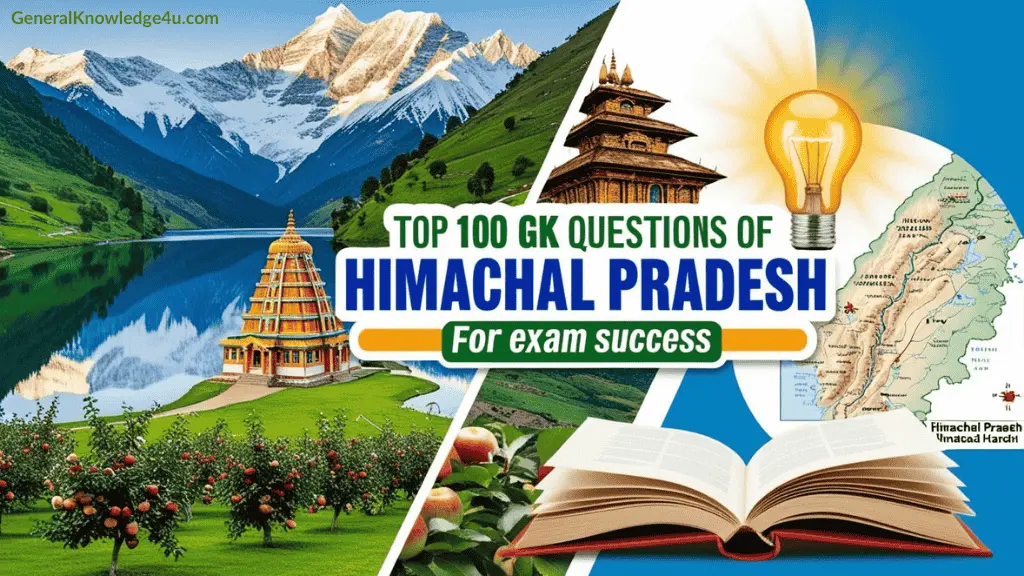
Welcome to the full “Complete 100 HP GK Questions & Answers 2025” guide! Himachal Pradesh, which is in the Western Himalayas, is more than just a pretty hill state. It’s a place with a lot of historical, cultural, and economic importance that shows up on a lot of competitive tests and is talked about a lot in national discussions.
This guide has been fully updated with information from 2025 and new ideas about how Himachal Pradesh is changing its role in India’s development story. You can find complete, up-to-date, and well-researched answers here whether you’re studying for HPPSC exams, SSC, Banking tests, or UPSC civil services or just want to learn more about this amazing state.
STATE OVERVIEW & ADMINISTRATION

By फ़िलप्रो (Filpro) – File:India dark grey.svg, CC BY-SA 4.0, Link
Q1. When was Himachal Pradesh formed as a state?
[1st November 1971]
Himachal Pradesh was officially established as a full state on 1st November 1971, marking the culmination of several administrative reorganizations that began with its formation as a union territory in 1956. This day is celebrated as Himachal Day across the state every year, commemorating its statehood achievement.
Q2. What is the capital of Himachal Pradesh?
[Shimla (summer), Dharamshala (winter)]
Himachal Pradesh follows a unique capital system with Shimla serving as the summer capital due to pleasant weather and favorable conditions from May to October, while Dharamshala functions as the winter capital from November to April, providing administrative continuity throughout the year.
Q3. How many districts does Himachal Pradesh have?
[12 districts]
Himachal Pradesh comprises 12 administrative districts: Bilaspur, Chamba, Hamirpur, Kangra, Kinnaur, Kullu, Lahaul & Spiti, Mandi, Shimla, Sirmaur, Solan, and Una. These are further divided into three administrative divisions and 78 development blocks serving the local governance structure.
Q4. What is the area of Himachal Pradesh?
[55,673 square kilometers]
Covering 55,673 square kilometers (21,495 sq mi), Himachal Pradesh represents approximately 1.69% of India’s total geographical area, making it the 18th largest state by area, primarily characterized by mountainous terrain and elevated altitudes.
Q5. What is the population of Himachal Pradesh (2011 Census)?
[6.85 million or 6,856,509]
According to the 2011 Census, Himachal Pradesh has a population of approximately 6.85 million people, with current estimates suggesting the population has grown to about 7.8 million (78.54 lakhs) as of 2025, representing a growth rate of approximately 12.95% from 2001 to 2011.
Q6. How many Lok Sabha seats does Himachal Pradesh have?
[4 seats]
Himachal Pradesh sends 4 representatives to the Lok Sabha (Lower House of Parliament) and 3 representatives to the Rajya Sabha (Upper House), reflecting its significant political representation in the national legislature.
Q7. How many assembly constituencies are there in Himachal Pradesh?
[68 constituencies]
Himachal Pradesh has 68 assembly constituencies spread across its 12 districts, with each constituency electing one Member of the Legislative Assembly (MLA) through democratic elections held every five years.
Q8. Which state borders Himachal Pradesh to the north?
[Ladakh (Union Territory)]
To the north, Himachal Pradesh shares its border with Ladakh, which was separated as a separate Union Territory in 2019. Historically, it shared borders with the state of Jammu & Kashmir before the administrative reorganization.
Q9. Which country does Himachal Pradesh border internationally?
[Tibet Autonomous Region, China]
Himachal Pradesh shares an international border with Tibet Autonomous Region (China) along its northeastern frontier, specifically through Spiti and Kinnaur districts, an area of strategic and geopolitical significance.
Q10. Which state is to the west of Himachal Pradesh?
[Punjab]
Punjab lies to the west of Himachal Pradesh, forming a significant interstate boundary. The plains of Punjab contrast sharply with the mountainous terrain of Himachal Pradesh, creating a distinct geographical transition zone.
GEOGRAPHY & TOPOGRAPHY
Q11. In which Himalayan range is Himachal Pradesh located?
[Western Himalayas]
Himachal Pradesh is situated in the Western Himalayan region, characterized by the complex mountain ranges including the Great Himalayas, Lesser Himalayas (Dhauladhar, Pir Panjal), and the Shivalik range, creating diverse topographical features.
Q12. What is the highest peak in Himachal Pradesh?
[Reo Purgyil (6,816 meters)]
Reo Purgyil, located in Kinnaur district, stands at 6,816 meters above sea level, making it the highest mountain peak in Himachal Pradesh. It is also known as Kailash Peak and holds cultural significance for local communities.
Q13. What is the second highest peak in Himachal Pradesh?
[Shilla Peak (7,025 meters)]
Wait – correction needed: Shilla Peak at 7,025 meters is actually higher than Reo Purgyil. Shilla Peak in Kinnaur district is the state’s highest peak, while Reo Purgyil is the second highest at 6,816 meters in the Western Himalayas.
Q14. Which is the smallest district by area in Himachal Pradesh?
[Hamirpur (1,118 sq km)]
Hamirpur is the smallest district by area, covering only 1,118 square kilometers. Despite its small geographical area, it has the highest population density among all districts due to intensive agricultural practices and settlements.
Q15. Which is the largest district by area in Himachal Pradesh?
[Lahaul & Spiti (13,835 sq km)]
Lahaul & Spiti is the largest district by area, spanning 13,835 square kilometers. However, it has the lowest population density with only about 31,528 people, reflecting its remote high-altitude mountainous terrain and challenging living conditions.
Q16. Which is the most populated district in Himachal Pradesh?
[Kangra District (1.5 million)]
Kangra District is the most populous with a population of 1,507,223 (2011 Census), accounting for approximately 22% of the state’s total population, making it a major political and administrative center.
Q17. Which district has the highest population density?
[Hamirpur (406 persons per sq km)]
Hamirpur has the highest population density at 406 persons per square kilometer, making it the most densely populated district despite being the smallest, resulting from concentrated settlements and agricultural productivity.
Q18. Which is the last village in Himachal Pradesh near the Indo-China border?
[Chittkul (in Kinnaur)]
Chittkul, located in Kinnaur district along the Indo-China border, is the last inhabited village in India, marking the geographical limit of Indian territory. It sits at approximately 3,680 meters altitude on the Sutlej River bank.
Q19. Which valley is known as the “Queen of Valleys”?
[Kullu Valley]
Kullu Valley, carved by the Beas River, is renowned for its breathtaking natural beauty, verdant landscapes, and cultural richness, earning it the epithet “Queen of Valleys.” It is a major tourist destination and culturally significant region.
Q20. Which valley is known for apple cultivation?
[Shimla Hills and surrounding areas in Kinnaur, Kullu, and Mandi]
The Shimla Hills and elevated regions of Kinnaur, Kullu, and Mandi districts are renowned for extensive apple cultivation, benefiting from ideal climatic conditions, altitude, and soil composition that produce premium-quality apples.

RIVERS, LAKES & WATER BODIES
Q21. Which is the longest river in Himachal Pradesh?
[Sutlej River]
The Sutlej (also spelled Satluj) River, at approximately 1,050 kilometers, is the longest river flowing through and originating from Himachal Pradesh. It enters the state near Shipki in Kinnaur and serves multiple purposes including irrigation, hydroelectric power generation, and cultural significance.
Q22. Which river is called the “Sorrow of Himachal Pradesh”?
[Swan River]
The Swan (Svein) River is called the “Sorrow of Himachal Pradesh” due to its devastating flooding patterns during monsoon season, causing frequent damage to crops, infrastructure, and causing loss of life. Controlling its floods remains a persistent challenge for the state.
Q23. Which river is known as the “Moon River”?
[Chenab River]
The Chenab River, formed by the confluence of the Chandra and Bhaga rivers, is poetically called the “Moon River.” The name “Chenab” is derived from Sanskrit “Chandabhaga,” meaning “Moon water,” reflecting its cultural and geographical significance.
Q24. Which rivers originate in Himachal Pradesh?
[Sutlej, Chenab, Ravi, Beas, and Yamuna rivers]
Five major rivers originate wholly or partly in Himachal Pradesh: the Sutlej, Chenab, Ravi, Beas, and Yamuna. These rivers form the crucial drainage system, providing water to both the Indus and Ganges basins that sustain millions of people.
Q25. How many “Prayags” (sacred river confluences) are there in Himachal Pradesh?
[Panch Prayag – Five confluences]
Himachal Pradesh has five sacred river confluences collectively known as Panch Prayag: Devprayag (Alaknanda-Bhagirathi), Rudraprayag (Alaknanda-Mandakini), Nandprayag (Alaknanda-Nandakini), Karnaprayag (Alaknanda-Pinyar), and Vishnuprayag (Alaknanda-Dhauli Ganga). These hold immense religious and cultural significance.
Q26. What is the largest freshwater lake in Himachal Pradesh?
[Renuka Lake (in Sirmaur)]
Renuka Lake, located in Sirmaur district near Paonta, is the largest freshwater lake in Himachal Pradesh, covering approximately 5.9 square kilometers. It holds mythological significance and is a popular tourist destination surrounded by scenic forested hills.
Q27. Which is the artificial lake in Himachal Pradesh?
[Govind Sagar Lake (created by Bhakra Dam)]
Govind Sagar, created by the Bhakra Dam on the Sutlej River, is an artificial reservoir extending across Himachal Pradesh and Punjab, spanning approximately 90 kilometers. It is one of India’s largest reservoirs, serving irrigation, hydroelectric power, and tourism purposes.
Q28. Which river is also called the “Sky River”?
[Note: The Brahmaputra is called Sky River, not a Himachal river]
The Brahmaputra River in Northeast India is poetically called the “Sky River” due to its immense scale and flowing like a ribbon across the landscape. In Himachal Pradesh context, rivers are typically identified by their local/Sanskrit names reflecting regional importance.
Q29. Which two famous lakes are located in Lahaul-Spiti district?
[Chandratal and Surajtal]
Chandratal (“Moon Lake”) and Surajtal (“Sun Lake”) are two stunning high-altitude lakes located in Lahaul-Spiti district at approximately 4,300 meters elevation. These pristine alpine lakes are popular trekking destinations despite their remote locations and challenging accessibility.
Q30. What is the Kulu Sarpa or Beas Kund?
[Source of Beas River]
Beas Kund, located in Kullu district at approximately 4,219 meters altitude, is the glacial source of the Beas River. This high-altitude lake, surrounded by snow-capped peaks and meadows, is a significant geographical feature and trekking destination.
WILDLIFE & NATIONAL PARKS

By snotch – Own work, Public Domain, Link
Q31. How many national parks does Himachal Pradesh have?
[5 National Parks]
Himachal Pradesh has five national parks: Great Himalayan National Park, Pin Valley National Park, Inderkilla National Park, Khirganga National Park, and Simbalbara National Park, protecting diverse ecosystems and endangered species across various altitudinal zones.
Q32. Which is the largest national park in Himachal Pradesh?
[Great Himalayan National Park (90,495 hectares)]
Great Himalayan National Park, spread across 90,495 hectares in Kullu, Mandi, and Shimla districts, is the largest and most biodiverse national park in Himachal Pradesh. It is also designated as a UNESCO World Heritage Site, containing temperate forests and high-altitude ecosystems.
Q33. Which national park is known for high-altitude arid ecosystem?
[Pin Valley National Park]
Pin Valley National Park in Spiti district, located at extremely high altitudes (3,500-6,500m), features rare arid alpine ecosystems distinct from other parks. It is home to endangered species like snow leopards, Siberian ibex, and Himalayan blue sheep adapted to harsh conditions.
Q34. How many wildlife sanctuaries does Himachal Pradesh have?
[7-8 Wildlife Sanctuaries]
Himachal Pradesh has 7-8 wildlife sanctuaries including Daranghati, Khokhan, Talra, Pong Dam Lake (Maharana Pratap Sagar), Rupi-Bhaba, Gamgul-Saithai, and Shilli, distributed across various districts protecting specific ecosystems and species habitats.
Q35. What is the state animal of Himachal Pradesh?
[Snow Leopard]
The Snow Leopard (Panthera uncia) is the state animal, representing Himachal Pradesh’s commitment to high-altitude wildlife conservation. Recent surveys estimate approximately 83 snow leopards in the state, representing an increase from previous counts, indicating successful conservation efforts.
Q36. What is the state bird of Himachal Pradesh?
[Western Tragopan (Jujurana)]
The Western Tragopan (Tragopan melanocephalus), locally called “Jujurana,” is the state bird distinguished by its brightly colored plumage and elaborate courtship displays. With a global population under 3,500, it represents a critically endangered species requiring active protection.

By J.M.Garg – Own work, CC BY-SA 3.0, Link
Q37. What is the state fish of Himachal Pradesh?
[Golden Mahseer (Tor putitora)]
The Golden Mahseer (Tor putitora) is the state fish, found in Himalayan rivers and prized for its size and game fishing value. This species plays a crucial ecological role in river ecosystems but faces threats from habitat degradation and overfishing.
Q38. What is the state tree of Himachal Pradesh?
[Himalayan Deodar or Deodar Cedar (Cedrus deodara)]
The Himalayan Deodar (Cedrus deodara), also called Deodar Cedar, is the state tree representing Himachal Pradesh’s rich forest heritage. These magnificent trees, reaching heights of 50+ meters, have immense ecological and cultural significance in Himalayan ecology.
Q39. What is the state flower of Himachal Pradesh?
[Pink Rhododendron (Buransh)]
The Pink Rhododendron (locally called Buransh) is the state flower, blooming in March-April across high-altitude forested areas creating spectacular displays of pink blossoms. It holds cultural significance in local traditions and represents natural beauty of the state.
_India_2.png#/media/File:Snow_Leopards_-_Ghost_of_the_Mountains_for_Ministry_of_Tourism_(MOT)_India_2.png)
By Snow Leopard Trust, CC BY 3.0, Link
Q40. What is the state fruit of Himachal Pradesh?
[Apple]
The Apple is the state fruit, reflecting Himachal Pradesh’s global recognition as the “Apple Bowl of India.” High-altitude regions produce premium-quality apples exported worldwide, with the fruit economically pivotal to the state’s agricultural sector and rural livelihoods.
HISTORY & FORMATION

By HogweardIndia Himachal Pradesh relief map.svg: C1MMRajput Kingdoms of Himachal Pradesh.png: GujaratiHistoryinDNA – India Himachal Pradesh relief map.svgRajput Kingdoms of Himachal Pradesh.pngOwn work, Public Domain, Link
Q41. When did Himachal Pradesh become a Union Territory?
[1956]
Himachal Pradesh was declared a Union Territory on 1st November 1956, following the dissolution of the princely states. This marked a significant administrative transition from multiple independent princely states to a unified territorial administration under the Indian Union.
Q42. Which princely state was the most important in historical Himachal Pradesh?
[Kangra Kingdom]
Kangra Kingdom, ruled by the Katoch dynasty, was the most significant and powerful princely state in the region. Kangra Fort stood as a symbol of power, surviving various invasions and changing rulers from the Mughals to the Sikhs to the British.
Q43. When was the Kangra Kingdom established?
[Ancient period – Traditional claim dates to Mahabharata era]
The Kangra Kingdom claims antiquity dating back to the Mahabharata period, though documented history suggests it emerged more clearly during the medieval period. The Katoch rulers maintained continuity of rule for approximately 1,200 years, making it one of India’s longest-ruling dynasties.
Q44. Who was Maharaja Sansar Chand?
[Last major independent ruler of Kangra (r. 1775-1823)]
Maharaja Sansar Chand (1775-1823) was the last significant independent ruler of Kangra who expanded kingdom boundaries and established supremacy over surrounding hill states. His reign represented the pinnacle of Katoch power before decline under external pressures from Sikhs and British.
Q45. When did British rule begin in Himachal Pradesh?
[1846-1948]
British rule commenced after the First Anglo-Sikh War (1846), with the Treaty of Amritsar transferring Kangra and other areas to British control. Various kingdoms gradually came under British suzerainty, establishing colonial administration until independence in 1947.
Q46. Who was Yashwant Singh Parmar?
[First Chief Minister of Himachal Pradesh (1948-1952)]
Yashwant Singh Parmar served as the first Chief Minister of the former Himachal Pradesh state (1948-1952), leading the transition from princely state status to integration with the Indian Union and establishing democratic governance structures.
Q47. When was Himachal Pradesh separated from Uttar Pradesh?
[1st November 1966]
Following the dissolution of Punjab state and reorganization of states based on linguistic lines, Himachal Pradesh was separated from Uttar Pradesh and established as a separate Union Territory on 1st November 1966, eventually achieving full statehood in 1971.
Q48. What was the Praja Mandal Movement?
[Political movement against princely state rule in Himachal Pradesh]
The Praja Mandal Movement was a democratic political movement against authoritarian rule in Himachal Pradesh’s princely states during the independence struggle. It sought to establish representative government and civil liberties, contributing significantly to democratic transitions.
Q49. Who established Jwalamukhi Temple?
[Bhumi Chand (Katoch dynasty founder)]
Bhumi Chand, founder of the Katoch dynasty, is credited with establishing the Jwalamukhi Temple, one of the most significant religious sites in Himachal Pradesh. The temple represents the intersection of political power and spiritual authority in the region’s history.
Q50. When did Himachal Pradesh achieve full statehood?
[1st November 1971]
After serving as a Union Territory for 15 years (1956-1971), Himachal Pradesh achieved full statehood on 1st November 1971, gaining constitutional autonomy, legislative assembly, and increased administrative independence to govern its affairs.
CULTURE, FESTIVALS & TRADITIONS
Q51. What is the main festival of Himachal Pradesh?
[Kullu Dussehra]
Kullu Dussehra, celebrated for seven days starting from Vijay Dashmi (10th day after Dussehra in other parts of India), is unique and distinct from typical Dussehra celebrations. It features processions of hundreds of deity idols on palanquins, traditional Nati dances, and cultural performances, earning international recognition.

Q52. When is Kullu Dussehra celebrated?
[Starting Vijay Dashmi, lasting 7 days (Usually October)]
Kullu Dussehra begins on Vijay Dashmi and extends for a full week, typically in October, creating an entire carnival atmosphere. Unlike other regions where Dussehra is brief, Kullu’s week-long celebration showcases the region’s unique cultural traditions and democratic celebration of spirituality.
Q53. What is the origin of Kullu Dussehra?
[Established by Raja Jagat Singh in 17th century]
In the 17th century, Raja Jagat Singh of Kullu installed an idol of Lord Raghunath on his throne as an act of penance, establishing the deity as the ruling god of Kullu Valley. This historical gesture initiated the tradition of celebrating Dussehra in this distinctive manner.
Q54. What is Nati dance?
[Traditional folk dance of Himachal Pradesh]
Nati is the most popular traditional folk dance of Himachal Pradesh, performed by both men and women in circular formations with rhythmic body movements and hand gestures. Accompanied by traditional drums (Dhol) and local instruments, it represents happiness, celebration, and cultural unity.
Q55. What other traditional dances are performed in Himachal Pradesh?
[Chamba Rumal embroidery dance, Barah Maha, Giddha variations, and Jharana]
Besides Nati, Himachal Pradesh features regional dances like Chamba Chikhalı́ (representing embroidery art through dance), Barah Maha (twelve-month cycle celebrations), Jharana (energy-filled jumping dance), and various Giddha adaptations with local cultural modifications.
Q56. When is Lohri celebrated?
[13th January, marking end of winter]
Lohri is celebrated on 13th January annually, marking the end of the harsh winter season and welcoming spring. This harvest festival features bonfires where people burn wood and crop residue, distribute sweets and popcorn, and celebrate agricultural prosperity.
Q57. What is the significance of Mandi Shivratri?
[One of the oldest fairs in Himachal Pradesh]
Mandi Shivratri, celebrated in February-March around Shivratri, is one of the most ancient and celebrated fairs in Himachal Pradesh held for centuries. Hundreds of deities from surrounding areas are brought to Mandi for a grand fair featuring cultural performances, crafts, and devotional rituals.
Q58. What are the traditional clothes of Himachal Pradesh?
[Chamba Pahari, Kangra dresses, Kinnauri shawls]
Traditional Himachali dress varies by region: Chamba Pahari dress, Kangra traditional attire with distinct patterns, and Kinnauri shawls known for fine weaving. These colorful garments with intricate embroidery and regional designs represent the state’s cultural identity and skilled craftsmanship.
Q59. What is Pahari cuisine famous for?
[Madra, Meetha Chaawal, Dhaam, Chutneys]
Pahari (Himachali) cuisine is famous for traditional dishes like Madra (yogurt-based curry), Meetha Chaawal (sweet rice), Dhaam (elaborate ceremonial multi-course meal), and unique chutneys. Food reflects high-altitude ingredients, preservation techniques, and cultural dining traditions.
Q60. What are traditional Himachali crafts?
[Chamba Rumal, Kinnauri Shawls, Kangra Art, Thangka paintings]
Himachal Pradesh is renowned for traditional crafts including Chamba Rumal (embroidered cloth), Kinnauri Shawls (fine woolen textiles), Kangra Art (miniature paintings), and Thangka paintings (Buddhist religious artworks), representing centuries of artistic excellence.
ECONOMY & AGRICULTURE

By Original: PanWoyteczekDerivative work: UnpetitproleX – This file was derived from: Paralotniarstwo 02.jpg, CC BY-SA 4.0, Link
Q61. What is Himachal Pradesh known as regarding agriculture?
[Apple Bowl of India / Horticultural State of India]
Himachal Pradesh is famously called the “Apple Bowl of India” due to being the world’s leading apple-producing region with approximately 300,000 farming families engaged in apple cultivation across Shimla, Kullu, Kinnaur, and Mandi districts.

Q62. When was apple cultivation introduced in Himachal Pradesh?
[Mid-19th century by British officer R.C. Lee]
British officer R.C. Lee introduced commercial apple cultivation to Himachal Pradesh during the mid-19th century, particularly in the Shimla hills. This agricultural innovation transformed the regional economy and eventually made the state India’s premier apple producer.
Q63. Which district produces the most apples in Himachal Pradesh?
[Shimla District]
Shimla district is the largest apple-producing region in Himachal Pradesh, followed by Kullu, Kinnaur, and Mandi districts. The high altitude (1,500-2,500 meters), cool climate, and suitable soil conditions create ideal growing environments for premium-quality apples.
Q64. What is the contribution of apple farming to Himachal Pradesh’s economy?
[Approximately ₹5,000 crore annually in horticultural sector]
Apple farming contributes significantly to the state’s economy, generating approximately ₹5,000 crore in the horticultural sector annually. It provides livelihood to over 300,000 families, drives ancillary industries (packaging, transportation, cold storage), and represents the state’s economic backbone.
Q65. Which other crops are grown in Himachal Pradesh?
[Wheat, Maize, Barley, Grapes, Stone fruits, Tea, Hops]
Besides apples, Himachal Pradesh cultivates wheat, maize, barley in mid and lower elevations, while higher areas grow grapes (especially in Kinnaur), stone fruits (apricots, cherries), tea in Palampur region, and hops for brewing industry.
Q66. What is the highest grape-producing district?
[Kinnaur District]
Kinnaur district is the highest grape-producing region in Himachal Pradesh, with ideal climatic conditions for cultivating premium wine grapes. Local apricots, walnuts, and cherries are also significantly produced in this high-altitude district.
Q67. What is the major floriculture center in Himachal Pradesh?
[Solan District]
Solan district has emerged as the major floriculture center of Himachal Pradesh, producing flowers commercially for domestic and export markets. The region’s pleasant climate and agricultural infrastructure support diverse flower cultivation.
Q68. What is the significance of irrigation in Himachal Pradesh?
[Critical for agricultural productivity given varying rainfall]
Irrigation systems including Kuhls (traditional channels), Western Yamuna Canal system, and modern schemes like PMKSY (Pradhan Mantri Krishi Sinchayee Yojana) are crucial for agricultural sustainability, as rainfall distribution varies significantly across altitude zones.
Q69. What is a Kuhl?
[Traditional water channel system in Himachal Pradesh]
Kuhls are ancient gravity-fed irrigation channels historically constructed by mountain communities to channel water from mountain streams to agricultural fields. These sophisticated systems, often centuries old, represent indigenous water management innovation and remain vital for sustainable farming.
Q70. What is the state rank of Himachal Pradesh in horticultural production?
[Among top horticultural producing states in India]
Himachal Pradesh ranks among India’s top horticultural-producing states, contributing significantly to national fruit and vegetable production. The state’s diverse climate zones enable cultivation of diverse horticultural products from tropical to temperate varieties.
STATE SYMBOLS (DETAILED)

By Tojoroy20 – Own work, CC BY-SA 4.0, Link
Q71. What does the Deodar tree represent?
[Himalayan ecological heritage and permanence]
The Himalayan Deodar (Cedrus deodara), Himachal’s state tree, represents the state’s ecological richness, permanence, and connection to Himalayan heritage. These ancient trees, living for centuries, symbolize stability, strength, and the region’s commitment to forest conservation.
Q72. What is the mythology around Rhododendron?
[Associated with spring renewal and natural beauty]
Rhododendron (Buransh) blooming in spring symbolizes renewal, natural beauty, and cultural celebration in Himachal Pradesh. The flowering season is culturally significant, marking the transition to better weather and agricultural activities.
Q73. What is special about Golden Mahseer fish?
[Largest cyprinid fish, game fishing significance]
Golden Mahseer (Tor putitora) is among the largest cyprinid fish species, playing crucial ecological roles in Himalayan river ecosystems. Its designation as state fish reflects conservation priorities and the importance of maintaining river health and biodiversity.
Q74. What is the conservation status of Western Tragopan?
[Endangered species with declining population]
Western Tragopan (state bird) is classified as Endangered, with global population under 3,500 individuals. Habitat loss, poaching, and climate change threaten survival, making conservation initiatives critical for preventing extinction of this spectacular mountain bird species.
Q75. What does Snow Leopard symbolize in Himachal Pradesh?
[High-altitude ecosystem conservation]
Snow Leopard symbolizes Himachal Pradesh’s commitment to high-altitude wildlife conservation. Recent population surveys showing increase from 51 (previous estimate) to 83 individuals demonstrate successful conservation, representing hope for species recovery through protected area management and community involvement.
NOTABLE PERSONALITIES
Q76. Who is Charanjit Singh?
[Hockey player, 1964 Olympics gold medalist captain]
Charanjit Singh, born in Himachal Pradesh, was the captain of the Indian Hockey Team that won the gold medal at the 1964 Summer Olympics in Tokyo, representing India’s sporting excellence in international competitions.
Q77. Who is Madan Lal?
[Cricketer, 1983 World Cup winner]
Madan Lal, with ancestral connections to Hamirpur district, was a member of India’s legendary 1983 Cricket World Cup-winning team that defeated West Indies, marking a pivotal moment in Indian sporting history.
Q78. Who is the Great Khali?
[Professional wrestler Dalip Singh Rana from Sirmaur]
Dalip Singh Rana, known globally as “The Great Khali,” is a professional wrestler from Sirmaur district standing 7 feet 1 inch tall. He achieved international fame in WWE, winning world championships and appearing in Bollywood and Hollywood films.
Q79. Who is Samresh Jung?
[Sports shooter, Arjuna Award winner from Sirmaur]
Samresh Jung from Sirmaur is an accomplished sports shooter awarded the Arjuna Award (2002) for distinguished sporting excellence. He won multiple gold medals in Commonwealth Games and Asian Games, representing India in international shooting competitions.
Q80. Who is Captain Vikram Batra?
[Army officer, Param Vir Chakra recipient, Kargil War hero]
Captain Vikram Batra from Palampur was posthumously awarded the Param Vir Chakra (India’s highest military honor) for his exceptional bravery during the 1999 Kargil War. He remains an inspirational figure in Indian military history.
CURRENT AFFAIRS & GOVERNANCE
Q81. Who is the current Chief Minister of Himachal Pradesh (2025)?
[Sukhvinder Singh Sukhu]
Sukhvinder Singh Sukhu serves as Chief Minister of Himachal Pradesh from March 2023 onwards, leading the Congress government after the 2022 state assembly elections. He focuses on development, rural welfare, and good governance in the state.
Q82. Who is the Governor of Himachal Pradesh?
[Shiv Pratap Shukla]
Shiv Pratap Shukla serves as the Governor of Himachal Pradesh, representing the Constitutional head of state. The Governor performs ceremonial functions, grants administrative approvals, and ensures constitutional governance in the state.
Q83. How many assembly seats does Congress hold in Himachal Pradesh?
[Varies with elections – check recent election results]
The number of assembly seats held by Congress varies following state elections held every five years. After 2022 elections, Congress secured majority to form government, though exact seat counts may change with by-elections or political developments.

Q84. What is the literacy rate of Himachal Pradesh?
[78.82% – 82.80% (current estimates)]
Himachal Pradesh has a literacy rate of approximately 82.80%, among the highest in India, reflecting substantial investment in education. The state consistently ranks above national average in literacy indicators across both rural and urban areas.
Q85. What is the sex ratio in Himachal Pradesh?
[972 females per 1000 males]
The sex ratio in Himachal Pradesh is 972 females per 1000 males (2011 Census), representing a relatively balanced gender ratio. While below the ideal 1000:1 ratio, it remains better than several other Indian states.
MISCELLANEOUS & FUN FACTS
Q86. What is Shimla famous for?
[Summer capital, Tourism, Colonial architecture]
Shimla is famous as the summer capital of Himachal Pradesh, serving as the administrative center during favorable weather months. It is also renowned for scenic beauty, colonial architecture (reflecting British hill station heritage), and being a major tourist destination.
Q87. What is Manali famous for?
[Tourism, Adventure activities, Natural beauty]
Manali is famous for adventure tourism (trekking, paragliding, skiing), snow-capped mountains, dense forests, and being a honeymoon destination. Its combination of cultural richness (local traditions and temples) and natural beauty attracts millions of visitors annually.
Q88. What is Dharamshala known for?
[Tibetan culture, Dalai Lama residence, International Cricket Stadium]
Dharamshala is the winter capital of Himachal Pradesh and home to the Dalai Lama and Tibetan exile community. It is also known for hosting the HPCA Cricket Stadium, which has hosted international cricket matches and attracts cricket enthusiasts.
Q89. What is Spiti Valley famous for?
[Remote wilderness, Buddhist monasteries, Arid landscapes]
Spiti Valley in Lahaul-Spiti district is famous for its remote high-altitude landscapes, Buddhist monasteries (like Kye Monastery), and arid terrain creating otherworldly scenery. It represents one of India’s most remote and spiritually significant regions.
Q90. What are the Panch Ratna or Five Jewels of Himachal Pradesh?
[Top tourist destinations or significant sites]
Himachal Pradesh’s prominent tourist sites and significance include Shimla, Manali, Dharamshala, Kullu, and Mandi. These areas represent the state’s major tourist attractions and cultural centers, though the exact “Panch Ratna” designation may vary.
Q91. What is the state motto of Himachal Pradesh?
[Satyameva Jayate (Truth Alone Triumphs)]
The state motto “Satyameva Jayate,” meaning “Truth Alone Triumphs,” is derived from ancient Indian philosophy and represents Himachal Pradesh’s commitment to truthfulness, justice, and ethical governance.
Q92. How many airports are in Himachal Pradesh?
[3 airports]
Himachal Pradesh has three airports: Bhuntar Airport (Kullu), Kangra Airport (Dharamshala), and Shimla Airport. These airports facilitate connectivity, reduce travel time, and support tourism and business activities in the state.
Q93. What is the HPCA Cricket Stadium?
[International cricket venue in Dharamshala]
The HPCA (Himachal Pradesh Cricket Association) Stadium in Dharamshala is an international cricket venue hosting Ranji Trophy, IPL matches, and international fixtures. The scenic stadium at high altitude offers unique playing conditions and dramatic mountain backdrops.
Q94. How many national highways pass through Himachal Pradesh?
[Multiple national highways including NH3, NH5, etc.]
Several national highways connect Himachal Pradesh with other states: NH3 (Chandigarh-Mandi), NH5 (Kiratpur-Shimla), NH44 (Shimla-Sarahan), NH22 (Chandigarh-Manali), and others facilitating connectivity and commerce.
Q95. What is “Dev Bhoomi”?
[Land of the Gods]
“Dev Bhoomi” (Land of the Gods) is a poetic epithet for Himachal Pradesh, referring to its spiritual significance, abundant religious sites (temples, monasteries), sacred geography (mountains, rivers), and cultural traditions deeply connected to Hindu, Buddhist, and Tibetan spirituality.
Q96. What is the forest area of Himachal Pradesh?
[37,948 square kilometers]
Himachal Pradesh has 37,948 square kilometers of forest cover, representing about 68-69% of the state’s geographical area. These forests play crucial roles in maintaining ecological balance, supporting biodiversity, and providing livelihoods for local communities.
Q97. What percentage of Himachal Pradesh is forested?
[65-69% forest cover]
Approximately 65-69% of Himachal Pradesh remains forested, making it among India’s most thickly forested states. This extensive forest cover reflects historical conservation traditions and remains vital for climate regulation and biodiversity protection.
Q98. What are the major mineral resources in Himachal Pradesh?
[Limestone, Slate, Gypsum, Quartz, Coal]
Himachal Pradesh has significant deposits of limestone (for cement production), slate, gypsum, quartz, and coal. Mining operations contribute to the state economy while balancing environmental concerns and sustainable resource extraction practices.
Q99. What is the significance of the Western Himalayas location?
[Unique biodiversity, Climate influence, Water source]
Himachal Pradesh’s Western Himalayan location determines its unique biodiversity (endemic species), climate patterns (monsoon influence, snow), and role as major water source for multiple Indian rivers supporting millions downstream.
Q100. What is the population growth rate of Himachal Pradesh?
[12.95% (2001-2011), estimated lower currently]
Himachal Pradesh experienced 12.95% population growth between 2001 and 2011 Census, though growth rates have moderated since. The state maintains relatively lower population growth compared to national average, reflecting controlled urbanization and demographic stability.
Conclusion
Finally, learning the Top 100 HP GK Questions is important for anyone studying for Himachal Pradesh-related competitive tests. You can feel safe taking tests like HPPSC, HP TET, SSC, and banking tests if you know a lot about the state’s history, culture, geography, and current events. This blog has gone into great depth about the most important subjects, such as state symbols, farming, festivals, and what the state does to help run the country. You can be ready for any test and stay ahead of your studies if you use the HP GK Questions with Answers PDF and go over the top 100 questions again and again. This complete study guide will keep you up to date, help you get ready, and increase your chances of success. Wish you the best of luck as you try to do well on your tests!
FAQ.
What is the importance of HP GK for competitive exams?
HP GK is important for tests like HPPSC, HP TET, SSC, and banking tests because it checks how much you know about the history, society, geography, economy, and current events of Himachal Pradesh. If you know a lot about HP GK, you have a much better chance of passing these tests.
Where can I find reliable HP GK study material?
You can get the HP GK Questions with Answers PDF, which covers all the important topics you need to know for tests. It has questions about location, arts, history, current events, state symbols, and more. This study material is meant to help you learn a lot about Himachal Pradesh.
How often should I update myself on HP GK Current Affairs?
Keep up with the latest HP GK Current Affairs because exams may ask about changes in government, economic policies, and big events. You can stay up to date on the latest news by reading newspapers, following official government websites, and using current events PDFs.
How can I use HP GK Questions effectively for my exam preparation?
To get the most out of HP GK Questions, you should study them often and pay attention to learning about the most important parts of Himachal Pradesh. Write down important facts and go over them often. Taking practice tests and answering multiple-choice questions (MCQs) will also help you remember what you’ve learned.























Leave a Comment